The final day of TRNSMT 2026 caught the festival at its best: brighter, warmer, and looser than the rain-soaked opening stretch, with Glasgow Green settling into the easy confidence of a weekend that had finally found its footing. Sunshine swept away Friday’s downpours, the crowds arrived early and in good spirits, and Sunday quickly became a joyful celebration of Scottish talent, rising artists, and beloved festival favourites. By the time Lewis Capaldi returned for an emotional headline set, the day had already built the kind of shared, electric momentum that only the best festival finales can deliver.


Opening King Tut’s Stage, Vida set the tone well with bright, melodic indie that felt made for the early-afternoon sunshine. There was nothing forced or uncertain about their arrival: the guitars chimed warmly, the melodies landed with real clarity, and the band carried themselves with the relaxed, infectious optimism of a group genuinely enjoying the scale of the occasion. A sweet announcement that the frontman had recently become a father added an unexpectedly tender touch, turning an already lovely opening set into one of the day’s first genuinely human moments and one that the crowd embraced warmly.


BBC Introducing has long been one of TRNSMT’s most important pathways for exciting new Scottish voices, and Abbie Gordon more than justified her place with a poised, quietly impressive performance. Her soulful vocal tone gave the set its warm centre of gravity, but it was her composure that stood out most. She never felt the need to overplay the moment; instead, she let the songs breathe naturally and find their own space, suggesting an artist with the instincts and confidence to grow well beyond the smaller-stage circuit.


Perrie brought one of the weekend’s most polished and exciting pop spectacles to the main stage, and there was a real sense of anticipation surrounding her solo arrival. She balanced new material with the Little Mix favourites that many in the crowd had clearly come to hear, yet the set never felt like a nostalgia exercise. The vocals were crisp and confident, the staging had real sheen, and her presence was magnetic enough to command one of the loudest and most enthusiastic daytime crowds of the entire weekend.


One of Sunday’s most welcome surprises, Westside Cowboy gave King Tut’s Stage a thrilling jolt of raw guitar energy. Their set had a wonderfully scrappy, unvarnished charm that cut refreshingly through the day’s bigger pop moments: loose edges, punchy rhythms, and infectious enthusiasm. They felt like exactly the sort of band that festivals are built to reveal. The act you wander into casually and leave talking about excitedly, convinced you found something special before anyone else caught on.


By mid-afternoon, Two Door Cinema Club had Glasgow Green moving. Their catalogue remains almost absurdly well-suited to sun-drenched festival fields, and songs like What You Know, I Can Talk, and Something Good Can Work landed with the warm, easy familiarity of indie anthems that have lost none of their lift or joy. The band’s playful jokes about once calling Glasgow home, combined with their obvious delight at the unusually good weather, gave the set a lovely local warmth alongside a rush of pure, sunlit nostalgia.


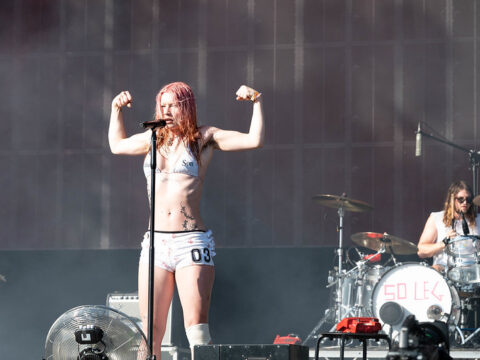
If Sunday had a standout performer below the headliner, CMAT made a very convincing case for the crown. Her set was a vivid, dazzling collision of country-pop melodrama, theatrical humour, and powerhouse vocals, delivered with the total confidence of someone entirely at home in her own wonderfully oddball universe. She moved easily from emotional songwriting to comic asides and crowd chants without ever losing her grip on the pace. It was funny, sharp, generous, and delightfully chaotic in all the right ways, a performance that made the entire field feel like her own personal stage.


Caity Baser kept King Tut’s Stage buzzing with an irresistible set built on bright pop hooks, quick wit, and genuine audience connection. Her songs arrived with the satisfying snap and immediacy of the best modern pop, but the performance worked because she filled every gap between the choruses with real personality. There was warmth and humour in the chat, honest emotion in the delivery, and a clear sense that younger fans were not simply watching a set but seeing themselves reflected in its energy.


Closing the BBC Introducing Stage, Shay O’Dowd delivered one of those accomplished, rewarding smaller-stage sets that repay closer attention. Built on strong musicianship and thoughtful songwriting, the performance felt measured and assured rather than showy, with the songs doing the heavy lifting. It served as a timely reminder that TRNSMT’s future is often visible away from the main stage, tucked in the corners where emerging artists are given the space to sharpen and define their identity in front of genuinely curious crowds.


Back on home ground, Amy MacDonald was greeted with the deep, heartfelt warmth reserved for artists whose songs have quietly become part of Scotland’s shared festival memory. Her set carried the calm, reassuring authority of a performer who understands what her catalogue means in this country, and she wisely let the songs do the emotional heavy lifting. Mr Rock & Roll and This Is the Life became enormous, open-throated singalongs, while her easy, natural charm made the whole performance feel both celebratory and grounded. As a lead-in to the headliner, she was just about perfect.
Skye Newman closed King Tut’s Stage with a confident, polished set that made clear why her profile is rising so quickly and so deservedly. Her impressive vocals and sleek modern pop production gave the performance a genuine contemporary gloss, but there was enough real presence and personality behind the sound to make it feel far more than well-produced. She left the stage having made a lasting impression, an artist who already feels like she is outgrowing the slot, and it would be no surprise to see her return to TRNSMT considerably higher up the bill in the years ahead.


The weekend’s most defining moment belonged, without question, to Lewis Capaldi. His return to TRNSMT after stepping back from touring carried enormous emotional weight, and the atmosphere shifted noticeably before he had even sung a single note. The reception that greeted him felt less like a standard headline welcome and more like a collective release, a crowd willing him through the moment as much as cheering his arrival. In that instant, the performance became something much bigger than a festival booking.
Capaldi balanced his trademark, endearing, self-deprecating humour with striking openness, reflecting honestly on the difficult period that had followed his previous TRNSMT appearance before telling the crowd he was “back and feeling better.” That honesty gave every song extra force. Before You Go, Wish You the Best, and Someone You Loved became vast, tearful communal singalongs, not merely performed but truly shared, with thousands of voices lifting them back towards the stage. His appreciation for Scottish music and emerging artists deepened the sense of occasion, and when fireworks lit up the sky above Glasgow Green, the set closed as both a triumphant comeback and a deeply moving homecoming.
Sunday delivered everything a festival finale should: glorious sunshine, impressive range, genuine discovery, fierce local pride, and a headline set charged with real emotional weight. What made it all work was the balance. The day moved from fresh new Scottish voices to glossy pop spectacle, from indie nostalgia to theatrical country-pop, from irresistible dance rhythms to one of the most affecting TRNSMT headline returns in recent memory. TRNSMT 2026 did not simply finish strongly. It found the moment and the image that will define the entire weekend.
Review by Karen Edmond
Photographs by James Edmond Photography