

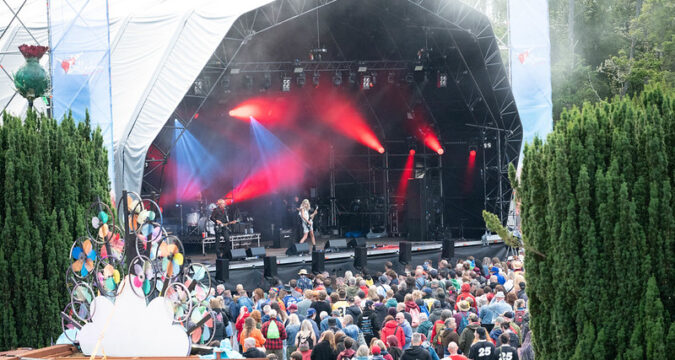
Belladrum Estate, Inverness-shire | Thursday 30 July 2026
Clouds hung heavy over the Belladrum Estate for most of Thursday, a stubborn grey that felt more weather forecast than weather fact. The Highlands, it seemed, enjoyed a reputation for drama even before the music began. Yet as the day wore on, the rain that had threatened to drench the opening slate of the festival held off, leaving the ground dry and the air charged with a different kind of electricity: relief, anticipation, and that familiar sense of a weekend about to unfold in unexpected ways.
The site, as ever, wore its festival personality with pride. Belladrum’s paths twist and reappear behind trees, the stages appear where least expected, and the “you never know what’s around the next bend” thrill is part of the daily routine. By afternoon, blankets appeared on the grass, children darted between rides and stalls, and the rest of the crowd settled into the comfortable rhythm of a festival that rewards curiosity as much as punctuality. The map, helpful though it is, remained a rough guide to the sensory geography of the place: a festival that invites you to wander is also a festival that rewards you for doing so.


The day’s tempo was set early by momentum, and momentum was supplied in spades by The Molotovs on the Garden Stage. There was no soft launch here; the band leapt straight into the sprint. Their debut album, Wasted On Youth, has been a talking point for weeks, and on stage it translated into a rush of lean, direct energy. The Cartlidge siblings, Issey and Matthew, drove the performance with a physical, unvarnished confidence that felt almost cinematic in its immediacy. The guitars came quick and sharp, the drums punched with a brisk authority, and the crowd moved as one, drawn by the sense that every note was meant to be lived in the moment rather than saved for later.
The set also carried the playful swagger that characterises the best mod-punk outfits: a cover of David Bowie’s “Suffragette City” landed with a communal cheer, a reminder that at Belladrum, the past and the present can collide with thrilling clarity. The coverage of the set’s energy was unrelenting, sometimes to the point where the transitions between songs blurred into a single breathless rush. Yet even at peak velocity, the conviction behind every chord suggested more than mere tempo: there was a band staking a claim to the afternoon, and the crowd responded in kind.


If The Molotovs supplied the spark, The Scratch fanned it into a full blaze. The Irish quartet have long made their reputation by turning acoustic instrumentation into something electric, and Thursday’s Garden Stage show was a masterclass in controlled chaos. “Pullin’ Teeth” and “Gladrags” demonstrated how traditional folk shapes can be reassembled into a kinetic, percussive engine that drives a crowd to move in unison. The set’s arc felt less like a sequence of songs and more like a continuous, evolving conversation — instruments and voices trading phrases as if in a living, ongoing dialogue with the audience.
The Scratch inhabit a space that many bands only reach in betwixt sets: a moment when everyone in the field becomes an active participant rather than a passive observer. The band’s instinct for timing and audience interaction turned the Garden Stage into a party that could not be easily paused. There were, of course, moments when intensity pulled tight and risked toppling into overload, but the discipline still on display kept the whole enterprise coherent. By the end, the noise had become a shared act rather than a one-sided performance, a festival in miniature with The Scratch at the helm.
Between these high-energy bursts, Cammy Barnes offered a moment of breathing space on the Hothouse Stage. After the adrenaline of The Molotovs and The Scratch, Barnes’s set arrived like a fresh lake after a long climb: calm, clear and deeply human. His delivery — warm, intimate, and quietly confident — invited the audience to lean in rather than cheer from a distance. The songs “Whisky Roll” and “Highland Runaway” landed with a warmth that felt personal without ever tipping into insular sentimentality. It was an ideal counterpoint to the earlier rounds: melody taking the foreground, story taking its rightful place, and space given to let the crowd reflect as well as participate.
That said, the set’s measured pace did invite a touch more edge or a surprise turn. In a day built on contrast, a sharper shift or an unexpected gear change might have sharpened the emotional arc. Yet the virtue of Barnes’s approach lay precisely in its ability to steady the tempo and re-centre the room, turning listening into an active choice rather than a passive experience. The result was a feeling of restoration; the audience was afforded a moment to catch their breath before the pop spectacle that followed.
Mika’s appearance on the Hothouse Stage brought Belladrum into its most conspicuously colourful realm. If Barnes offered a valley, Mika offered a carnival. The stage transformed into a kinetic canvas: choreography, light, and an energy that felt both inclusive and exuberant. The set list read as a masterclass in cross-generational pop appeal. “Modern Times” and “Big Girl (You Are Beautiful)” were as much about singalong unity as they were about the music itself, while “Lollipop” sent the energy soaring to a ridiculously high altitude. The audience’s engagement was a reminder of how festival performance thrives on spectacle as a form of communal experience, not merely individual attention.
Yet within the blaze of colour and movement, Mika’s show carried a subtler thread. The stronger, more vulnerable strand of his artistry peeked through in moments like “Happy Ending”, a reminder that behind the flamboyance there lies a songwriter who understands the fragility and honesty that can sit alongside bravura staging. The contrast between the exuberant foreground and the quieter, more introspective moments lent the set a fuller, more durable shape. It wasn’t just a party; it was a demonstration of why pop music, when staged with intention, can become a shared narrative rather than a mere auditory event.
The evening’s culmination belonged to Callum Beattie, stepping into his first major festival headline slot with a choice that sought connection over escalation. Beattie has long understood how to translate broad audience appeal into something intimate and shared, and his Belladrum show underscored that talent with quiet force. The set opened with “Two Pretenders” and moved through tracks that feel both distinctly Scottish and universally accessible. Beattie’s strength lies in his ability to make a sprawling festival feel intimate — as if the stage were a living room and the crowd a chorus that has waited to be invited to sing along.


A moment near the end stood out for its human resonance and its demonstration of Beattie’s character as a performer with purpose beyond the music. During “Something In My Eye”, children from a charity the artist supports were invited onto the stage, a gesture that carried more weight than any theatrical flourish. The room spoke in unison: a soft, shared warmth that turned a headline moment into a genuine communal experience. It was a reminder that at Belladrum, and perhaps at many festivals, the most memorable scenes are often the ones that reveal a festival’s values in action.
Musically, Beattie offered a closing arc that felt earned rather than engineered. The set balanced energy and tenderness, uplift with restraint, and crowd-pleasing warmth with moments of quiet reflection. When the arena quieted for the anthem-like closer “Heart Stops Beating”, the mood threaded together the night’s earlier eccentricities and the homegrown ethos that Belladrum has cultivated for years. The audience left with a sense of belonging that is as much about place as it is about performance.
Looking beyond the spectacle, Thursday’s opening day also laid bare Belladrum’s enduring appeal and its characteristic quirks. The estate’s winding geography remains part of the festival’s charm and its challenge. For every moment of seamless navigation, there is a corner that demands a little bravado on the part of festival-goers: wanderers’s luck, as much as timekeeping, often determines which acts become the night’s most memorable. The weather, a constant companion in the Highlands, offered a reminder that nature’s mood remains part of the festival’s texture. A near-miss downpour would have changed the day’s tone entirely; in the event, skies kept their drama in check, and music did the talking.
The question Belladrum invites — and answers, in its own unruly fashion — is this: can a festival live at the intersection of discovery, diversity and community? Day One suggested the answer is yes, and with room to grow. The Molotovs blasted open the afternoon’s energy; The Scratch carried that energy forward into communal celebration; Cammy Barnes provided necessary respite; Mika delivered a pop-carnival spectacle; and Callum Beattie closed with a sense of belonging that spoke to the crowd’s shared Highlands identity. It was a programme that leapt across styles, generations and moods, and the fact that it did so without feeling forced was perhaps the day’s most impressive achievement.
If any single thread ran through the day, it was this: Belladrum’s strength lies in its willingness to risk the slightly imperfect in pursuit of the truly memorable. The opening set’s potential missteps — moments of breathless pace that might have used a little more light and shade, a mid-tempo lull that could have sharpened the emotional contrast — were outweighed by the day’s generosity of spirit and the sense that anything could happen. In an age of tightly choreographed festivals, Belladrum’s unpredictability is a form of reassurance: you arrive with a plan, but you leave with a story.
So as the sun began to sink and the Highland dusk settled over the estate, the first day closed not with a single triumph but with a whispered promise. Three more days of music, weather permitting, lie ahead, and Belladrum’s landscape — both physical and musical — remains a stage for the unexpected. The stocktake of Day One is simple: a largely dry, emotionally charged opening that reminded festival fans why they keep returning to this place, year after year, with a compass angle tilted toward discovery and a heart tuned to celebration.
You arrive with a schedule. The festival sends you home with a story. On Thursday, Belladrum delivered one that felt at once intimate and expansive, rooted in homegrown warmth and buoyed by a willingness to chase whatever sound might be just beyond the next hill. It was not perfect, and it did not need to be. It was, in the best sense, Belladrum.
Review by Karen Edmond
Photographs by James Edmond Photography
