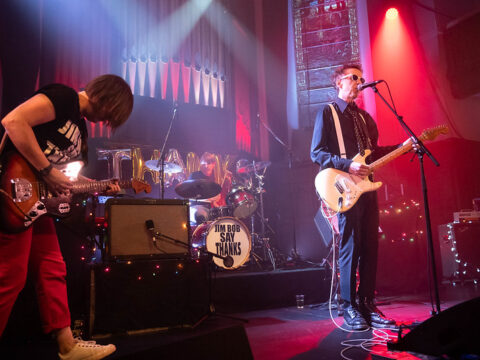
There is a peculiar alchemy to the Barrowland Ballroom that can make even a veteran act feel newly minted. The spring of the floorboards, the crackle of anticipation, that incandescent sign outside — they fuse into a piece of Glasgow mythology. On this damp Saturday the crowd packed the room for communion rather than mere back-patting. The Boomtown Rats, marking their 50th anniversary, were more than happy to oblige.
Support came from The Horn, a Britpop-leaning indie outfit whose sleek shimmer offset the Rats’ rougher edges. Their cover of Addicted to Love was a standout — chiming and buoyant, it hinted at bigger stages ahead. The audience took to them fast, and by the time they left the stage the room was already in full voice.


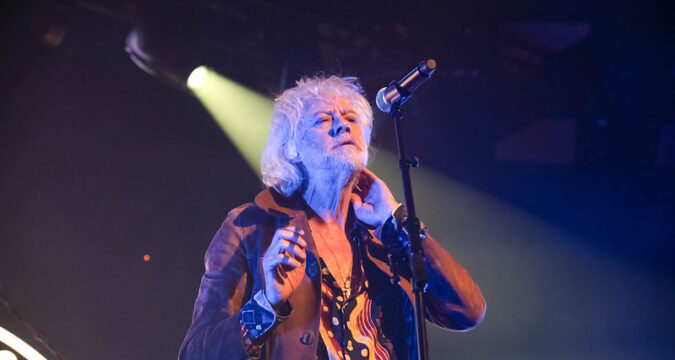
When Bob Geldof stalked on, tambourine aloft and shirt loud enough to tussle with the Barrowland lights, the years dissolved. At 74 he remains a born entertainer: part street preacher, part rock poet, part punk jester. “You’re not here for sentiment,” he barked early on. “You’re here to remember what it’s like to feel.” The crowd obliged, roaring like an old ritual.
The set detonated with Rat Trap — not coyly reserved for the encore but hurled into the fray from the off — a reclaiming of the Rats’ place in rock’n’roll’s unruly lineage. The song still snarls; Pete Briquette’s bassline thumped through the mix while Simon Crowe’s drums snapped and swung in lockstep. What once scored the discontent of youth now carries the muscle of survival.
She’s Gonna Do You in and Like Clockwork followed, their wiry bite and sharp hooks proof of how deftly the Rats always balanced punk’s fury with pop’s craft. Even cuts from 2020’s Citizens of Boomtown — Monster Monkeys in particular — slotted in with striking ease. The newer material bristled with synth-funk grit, the work of a band that refuses the static repose of nostalgia.
Geldof has long been half rock star, half raconteur. Between songs he mused on time’s elastic nonsense, on the shock of singing words written by his 25-year-old self, and on the fresh absurdities of the world — a subject he never dodges. Tonight, though, the patter felt less sermon and more confession, intimate and unguarded.
When I Don’t Like Mondays arrived — introduced with a dedication to “the children of Gaza, the kids in the fields of Ukraine, the mothers of Sudan” — the room shifted. For a song born of tragedy and outrage, it still stops time. Geldof’s voice cracked at moments, which deepened the sting. For a brief, flickering instant even the famously raucous Glasgow crowd fell silent.


If you have seen a show at the Barrowland you will know its magic lives in the feedback loop between band and audience. The floor literally springs with the people, a living testament to the building’s dance-hall past. Tonight, that kinetic energy was electric. From the front barrier to the back of the hall punters belted every line of Someone’s Looking at You and Banana Republic as if the lyrics were minted yesterday.
The band, for their part, looked genuinely moved. Geldof, ever the ringmaster, kept gesturing around the hall — “This,” he said, pointing to the throng, “is what it is all about. A holy place, this Barrowland.” It landed not as flattery but as benediction.
Half a century on, The Boomtown Rats are not chasing youth — they are interrogating it. The set felt less like a museum case and more like a meditation on continuity: how anger ages, how songs morph, how audiences carry the flame. Geldof may no longer spit invective, but his sneer has ripened into something tougher — a weathered defiance.
As the night closed with Looking After No. 1 the band locked into a tight, jubilant groove. Geldof, drenched and grinning, beamed at his comrades and let the song ride out in glorious racket. The encore — Diamond Smiles & The Boomtown Rats — was bittersweet, its melancholia braided with lift. The final chords rang like punctuation marks on a long, unruly story.
The Boomtown Rats’ 50th-anniversary tour could have been a respectful lap of honour. Instead, Glasgow got a show that was alive — vital, funny, occasionally ragged but never complacent. It reminded you that punk’s real gift was not only noise or rebellion but the refusal to stand still.
Fifty years on, Geldof and company are not merely surviving — they are still kicking against the pricks, still finding meaning in the din. Under the Barrowlands’ celestial glow, the Rats proved that growing older does not mean turning down.
Review by Karen Edmond
Photographs by James Edmond Photography