
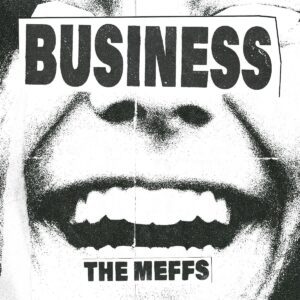
I’ve got business blasting through the living room speakers, louder than it probably needs to be, with a long-forgotten mug of coffee sitting beside my laptop. Cold now, a thin skin stretched across the surface. I haven’t touched it. By the time “Dreamin'” ends, I’ve abandoned whatever I was supposed to be doing, and I’m just listening.
That’s probably the most honest way I can describe The Meffs. They demand your attention.
The guitars buzz and snarl, the drums take a serious beating, and Lily Hopkins sounds like she’s been carrying a list of grievances and has finally run out of patience. Lewis Copsey sits right behind her, pushing everything forward at a pace that borders on reckless.
Business doesn’t linger. Eleven tracks, barely thirty minutes, almost nothing wasted.
“Dreamin'” is where the record reaches out and grabs you. The guitar carries that rough, slightly unkempt edge that suits The Meffs perfectly, while Copsey attacks the kit as though he’s already three songs deep. Hopkins doesn’t sound like someone introducing an album. She sounds like someone resuming an argument that started the day before. There is no gentle entry here.
“What A Nightmare” follows and somehow tightens the coil further. The verses carry a hemmed-in tension before the chorus breaks free, and Hopkins shifts between something almost conversational and something entirely furious. It’s a song about frustration that never needs to announce itself as one.
“Where Did It All Go Wrong?” gives the record something it hasn’t quite offered yet, a chorus that actually sticks. The guitars pull back just enough to let the vocal breathe, and suddenly there’s a line you catch yourself humming long after the song has finished. There’s a bruised quality to it as well. This isn’t another straight punch of punk aggression. There’s genuine regret buried underneath it.
“Business” shifts the angle entirely. Here, the band know exactly what they’re aiming at.
The music industry gets the full treatment: the branding, the packaging, and the instruction to sell yourself while somehow remaining authentic, with someone else quietly deciding what that authenticity is allowed to look like. The song carries a slyness that makes the critique land harder. Hopkins sounds like she’s thoroughly enjoying herself while dismantling the entire machine.
“Law” drops the slyness completely. It gets straight to the point and seems almost impatient to do so. There’s a stripped quality to it, Copsey’s drums carrying most of the weight while Hopkins spits the words out cleanly. It has the feel of someone levelling a finger and saying, No. This is wrong.
Then “Fight” arrives. Thirty-two seconds. Gone.
I actually appreciate that it refuses to become a proper song in any conventional sense. It’s an interruption, a short, sharp burst of noise and attitude, and any longer it would stop working. It’s better precisely because it doesn’t overstay its welcome.
“Disorder (Wake Up)” is where the fun drains out of the anger. This one carries genuine weight. The guitars sound heavier; the whole performance is less playful. Hopkins sounds authentically furious, but there’s exhaustion running beneath it. The song isn’t simply rallying everyone else to wake up. It sounds like someone who has been awake far too long and is beginning to feel it.
“Love To Lose” takes another turn entirely. The walls come down a little. The track doesn’t need the same frantic momentum as the earlier songs, and Hopkins sounds more exposed because of it. There’s still enough guitar and grit to keep it from tipping into sentiment, but the emotional core is far clearer here. It’s probably the moment on the record where you fully appreciate how much feeling has been sitting beneath all that noise.
“So Modern (Keep Up)” restores the nervous energy, but this time with a thread of humour woven through it. The rhythm feels permanently rushed, which suits a song about the exhausting effort of keeping pace with modern life. Technology, expectations, other people – everything seems to be accelerating just beyond your reach. It’s funny right up until you recognise it’s describing you.
“God Complex” arrives next, with Donots’ Ingo Knollmann lending an additional voice to the track. And it works.
Not because of any novelty in the guest appearance, but because the extra vocal genuinely adds another dimension. The song feels larger, more collective, like a group of people crowding into the same argument. The subject is arrogance and hypocrisy, but the delivery carries enough swagger to keep it from ever becoming a lecture.
When “Like Gravity” closes things out, the album feels as though it’s finally exhaling. This is the inward-looking one. The finger is no longer pointing at the industry, at society, or at anyone else’s inflated ego. The song feels closer and more personal, and Hopkins doesn’t need to push her voice to make it sting. There’s space here, and it’s that space that makes the final moments hit the hardest.
The album needs that ending. It earns it.
I glance over at the forgotten coffee beside me. Stone cold. But business still has plenty of heat left in it. I came for the noise and stayed for the songs, and I’m not quite ready to switch it off.
Review by James Edmond