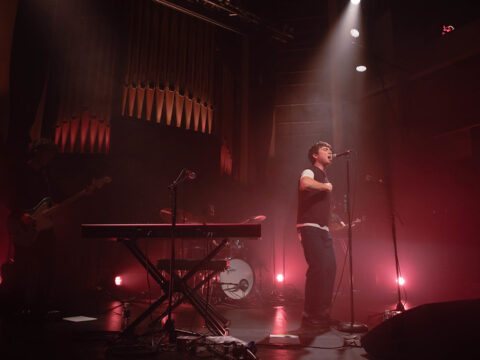
There’s something about seeing Graham Gouldman in a room the size of Saint Luke’s. This is a man whose songs have soundtracked decades of other people’s lives, often without them clocking just how much of his work they actually know. 10cc classics, hits he wrote for The Hollies, Herman’s Hermits, and others: his catalogue stretches well beyond any single band or era.
This wasn’t an evening of dusting off old records and letting nostalgia do the heavy lifting. It was a chance to hear the songwriting up close, to rediscover melodies you’d half forgotten, and to spend some time with the man behind them. A venue like Saint Luke’s suits Gouldman’s music. The songs have room to breathe, and the stories behind them end up mattering almost as much as the notes.
Something a bit strange happened before Gouldman even took the stage. Support act Seb Wesson had laryngitis. He told the crowd he could sing but couldn’t talk. I had to smile at that. You don’t hear it every day: a singer who can manage the songs but can barely speak between them.
Wesson got on with it anyway, playing three of his own songs: “Circles and Squares”, “Calais” and “Elizabeth”. It was a short set, but there was something admirable about him pushing through when his voice was clearly fighting him. Watching live music, you forget how much can go wrong before anyone’s even picked up an instrument. This was a small reminder.
Before he left the stage, Wesson made a point of telling us we hadn’t seen the last of him. He’d be back later, he said, playing in Gouldman’s band. That got my attention. Not often a support act gives you a reason to watch for them again during the headline set.
It added a nice twist to the night. Wesson had come out to introduce his own material while fighting laryngitis and then turned out to be part of the team bringing Gouldman’s songs to life. I spent a good chunk of the main set wondering how he’d fit in and whether I’d even notice when he showed up.
Unusual way to open a show. It made Wesson more memorable than most names that sit above the headliner on a bill.


The opening run set the tone fast. “Pamela, Pamela” was a lovely way to start, before Gouldman dug into the songwriting history that’s made him so familiar to generations of music fans, even if they couldn’t always put a name to the writer.
“Heart Full of Soul” brought The Yardbirds into the room, and “No Milk Today” reminded everyone how easily Gouldman could write a melody that lodges itself in your head for good.
Hearing these songs gathered in one set is something else. They belong to different decades and different scenes, yet there’s a thread running through all of them: a knack for finding the right tune, the right phrase, and the small detail that makes a song stick. Gouldman doesn’t need to make a case for himself. The songs do that.
When the set turned to “Good Morning Judge”, the 10cc connection came into full focus. There’s a particular pleasure in hearing these songs from someone who helped build them. Plenty of wit and musical intelligence in there, but underneath the cleverness, they’re just well-built pop songs.
“Floating in Heaven” and “Sunburn” added another shade to the night, while “Love’s Not for Me (Rene’s Song)” offered something quieter. Nothing about the set felt like a checklist of familiar titles. It felt more like Gouldman walking through a lifetime of writing, letting each song find its place.
Then came “Look Through Any Window”, one of the great Hollies songs. A reminder of how much of British pop Gouldman shaped from behind the scenes, even when someone else stood at the mic. The melody holds up beautifully, and hearing it live put the songwriting itself front and centre.
Plenty more followed: “Daylight”, “Dancing Days”, and the oddly charming “Play Me (The Ukulele Song)”, which shifted the pace nicely.





One of the best things about nights like this is how a song can drop you somewhere else entirely. A few bars in, and suddenly you’re back at an old radio, flicking through a record collection, remembering a stretch of life you hadn’t thought about in years. The music doesn’t need to explain itself. You bring your own memories along.
“Bridge to Your Heart”, originally recorded by Wax, was another reminder of how far Gouldman’s songwriting has travelled across bands and projects without losing its melodic core. Easy to forget how many corners of pop music carry his fingerprints.
Then “I’m Not in Love.”
Some songs get so familiar you stop really hearing them. Not this one. It’s still a remarkable piece of writing, built on an odd idea and a sound that hasn’t dated. There’s vulnerability under that cool surface, and that’s probably why it’s survived so many years of radio play.
Hearing Gouldman perform it himself brings the song’s origins into sharper focus. Not a classic wheeled out for applause. A reminder of the imagination it took to make in the first place.
The set rolled on with “That’s Love Right There” and “Say You Love Me Tonight”, before “Bus Stop” took us back to another of his best-known Hollies songs.
“Bus Stop” makes songwriting look deceptively simple. Simple story, instantly memorable melody, sharp enough details to put you right in the scene. That’s a rare gift. Plenty of writers can set words to music. Far fewer can make an ordinary moment feel worth keeping.
Then “The Things We Do for Love,” another 10cc song with a melody that feels like it’s always existed. Warmth, humour, and a recognisable truth about the stupid things people do when they’re in love. The kind of song that brings a room together without asking for anything more than a willingness to sing along.
“We’re Alive” and “Memory Lane” carried things forward, the latter title fitting for a night that had already travelled through so many chapters of pop history.
By this point, what struck me wasn’t just the sheer number of songs I recognised. It was realising how many of them came from one person. Gouldman has written music that’s been recorded, covered, and loved across generations, and hearing it all in one place makes the scale of what he’s done hard to ignore.
“For Your Love” closed the main set, another classic from his early years as a songwriter. A good choice to end on: direct, memorable, and still carrying the weight of a great pop song decades on.
Two more 10cc songs followed as the night wound down. “Ready to Go Home” offered a quieter moment before “Dreadlock Holiday” closed things out. That one has a character all its own: rhythmic swagger, plenty of humour, a chorus everyone in the room already knew by heart.
A fitting way to end a night that never stayed confined to one band or one period of his career. From the early hits written for other artists through to the songs that defined 10cc, the set celebrated a writer who’s spent decades finding new ways to make a melody stick.
Walking out of Saint Luke’s, it’s the songs that stay with you. “No Milk Today”, “Bus Stop”, “I’m Not in Love”, “The Things We Do for Love”. Different records, different memories, all tied together by a songwriter with an extraordinary ear for melody.
Seb Wesson opened the night with a set of his own songs, laryngitis and all, before telling us he’d be back as part of Gouldman’s band. A small, memorable twist, and proof that live music rarely goes quite the way you expect.
Gouldman then showed how far a lifetime of writing can travel, from other people’s hits to the unmistakable sound of 10cc. More than a trip down memory lane. A look at the craft behind the memories, delivered by the man who built them.
Some songwriters give you a hit. Graham Gouldman has given us a lifetime of them.
Review & Photographs by James Edmond Photography