

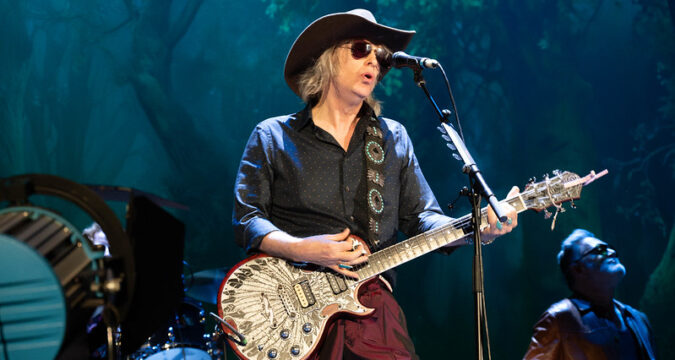
With no support band and the whole evening given over to The Waterboys, there was plenty of time for Mike Scott and the band to take their time and explore their music. And that is exactly what they did.
The Fisherman’s Blues Revue wasn’t simply a night of playing the big hits. Over 26 songs, The Waterboys moved between rock, folk, country, blues and traditional music, taking in some of the best-known songs from their catalogue alongside a few less obvious choices.
There was also the return of Steve Wickham, whose fiddle has always been such an important part of The Waterboys’ sound. His presence was one of the big talking points before the show, and once he appeared on stage, it was easy to see why. His playing brought an energy and character to the songs, particularly when the band moved towards the folkier material.
The first song of the night was “Don’t Bang the Drum”, and it was a big, powerful way to start. The sound filled the Hydro almost immediately, with Mike Scott looking completely comfortable at the front of the band. “Glastonbury Song” followed and got another big response, with the crowd quickly getting involved. Then came “How Long Will I Love You?”, which changed the mood completely. It was a much quieter moment and allowed the song itself to do the work rather than relying on the size of the venue.
“A Girl Called Johnny” took things back to the band’s early days. Even after all these years it still has plenty of energy, and it didn’t feel like a song being dragged out simply for nostalgia. Then came “The Whole of the Moon”. This was always going to be one of the biggest moments of the night, and the reaction from the Hydro proved it. The crowd were singing from the opening notes, and by the time the chorus arrived, thousands of voices were joining in. It is one of those songs that has grown well beyond the period when it was originally released, and hearing it sung by a packed Glasgow crowd was something else.
Scott himself was fairly understated throughout the evening. There were no long speeches or attempts to constantly work the crowd up. He seemed happy to let the songs and musicians take centre stage, which suited the show. “We Will Not Be Lovers” brought back some of the harder edge, followed by “Medicine Bow”, before the music started moving further into the traditional side of The Waterboys. “The Raggle Taggle Gipsy” was a great example of what Steve Wickham brings to the band. His fiddle wasn’t simply sitting in the background adding a bit of colour. It was right at the heart of the song, pushing it along and giving it a real sense of movement.
There were moments when his playing was delicate, and then he would suddenly let loose. That contrast worked brilliantly in the Hydro and reminded everyone why his return was such an important part of this show. “Sweet Thing / Blackbird” gave the musicians another chance to stretch out. It was one of those performances where you could simply stand back and listen to the band finding their way through the music. There were also some quieter and less obvious choices, including “Strange Boat” and the instrumental “Dunford’s Fancy”. These helped stop the show becoming one long run of familiar songs and gave the set a bit more variety.
The first half ended with “The Stolen Child”, The Waterboys’ setting of the W. B. Yeats poem. After everything that had come before it, the change in atmosphere was noticeable. The Hydro became surprisingly quiet, with the audience listening rather than singing along. It was a beautiful way to bring the first half to an end.
After the interval, things changed again. Steve Earle joined the band and opened his part of the evening with “Copperhead Road”. It was an immediate lift. The crowd were straight back on their feet, and Earle brought his own style to the stage, rough around the edges in exactly the right way.
There was no attempt to make “Copperhead Road” sound polished. It had the same grit and attitude that people have come to expect from Earle, and it worked particularly well alongside The Waterboys. “Guitar Town” kept the momentum going. Earle’s songs have a very different feel from Mike Scott’s, but there are obvious connections between them. Both writers are interested in people, places, travelling and the stories that come with them. “My Old Friend the Blues” slowed things down again and showed another side of Earle. It was followed by “I Ain’t Ever Satisfied”, which brought the energy back up. “Volver a Celaya” continued Earle’s run of songs and showed that his appearance wasn’t going to be just a quick guest spot. He had been given a proper section of the show and made the most of it.
The Rolling Stones’ “Dead Flowers” was another highlight. It fitted naturally into the evening, with its country-rock feel making it an obvious choice for Earle and The Waterboys. They didn’t try to copy the original and instead gave it their own relaxed treatment. The Waterboys then returned to the front of the stage, bringing the focus back to their own songs.
“When Will We Be Married?” had a much more relaxed, communal feel, while “When Ye Go Away” brought a more reflective side to the show. “Has Anybody Here Seen Hank?” added a bit of fun, with its Hank Williams reference fitting nicely into the mixture of country and folk that had developed during the evening.


“Come Back to Galway” brought the Irish influence back to the forefront and felt particularly appropriate given how important that musical tradition was to the Fisherman’s Blues period.
By this point, the audience was completely into the show. The fact there was no support act meant The Waterboys had plenty of time to let the concert build rather than having to rush through a shorter headline set. Some songs were huge crowd favourites, while others gave the musicians room to explore.
“And a Bang on the Ear” was another particularly good moment. It has that mixture of warmth and sadness that The Waterboys do so well, and the interaction between Scott and Earle made it feel different from simply listening to the record.
Then the end of the night started to come into view. Earle returned for the encore, and “The Galway Girl” produced another massive reaction from the crowd. It was exactly the kind of song that could bring everyone together, mixing Earle’s country sound with the Irish and Celtic influences that had been running through the concert.
And then it was time for “Fisherman’s Blues”. The opening fiddle immediately changed the atmosphere, and suddenly the whole evening made sense. Steve Wickham’s playing was once again at the centre of things, while Mike Scott delivered the song with the same sense of longing that has made it such an enduring favourite.
The Hydro turned into one huge singalong. There can’t be many better places to hear thousands of people singing “Fisherman’s Blues” together. It was familiar, obviously, but it didn’t feel tired or routine. The song still has something about it that connects with people. Wickham’s fiddle was a huge part of that. It gave the song its lift and helped create that mixture of joy and melancholy that makes it so special.
The final song was “Will the Circle Be Unbroken?”, bringing the full company together for a fitting finish. After an evening that had travelled through folk, rock, country, blues and Americana, it felt like the right way to finish.
The Hydro isn’t necessarily the perfect venue for every part of a show like this. Some of the quieter songs would probably have had even more impact in a smaller theatre or hall, where the detail of the music could be heard more easily. But when the band went big, the Hydro worked brilliantly. “The Whole of the Moon”, “Copperhead Road” and “Fisherman’s Blues” all benefited from the size of the crowd. The audience wasn’t just watching the show during those songs – they became part of it.
For a band that has been around for more than four decades, The Waterboys still sound like a group that wants to keep exploring. Mike Scott has taken the band through plenty of different musical directions over the years, but the sense of curiosity is still there. The return of Steve Wickham was one of the main reasons this particular show felt special. His fiddle brought back an important part of The Waterboys’ sound, while Steve Earle added something completely different without ever feeling out of place.
Most importantly, the songs still worked. From “Don’t Bang the Drum” at the start, through “The Whole of the Moon”, Earle’s “Copperhead Road”, the quieter “And a Bang on the Ear” and finally “Fisherman’s Blues”, there were plenty of moments for the Glasgow crowd to remember.
With no support act and the whole evening to themselves, The Waterboys were able to put together a show that felt more like a musical journey than a standard greatest-hits concert. It was a long night, but there was plenty to keep you there.
And when the final notes of “Will the Circle Be Unbroken?” rang around the Hydro, it felt like a fitting end to a celebration of The Waterboys, their history and, most importantly, their music.
Review by Karen Edmond
Photographs by James Edmond Photography


