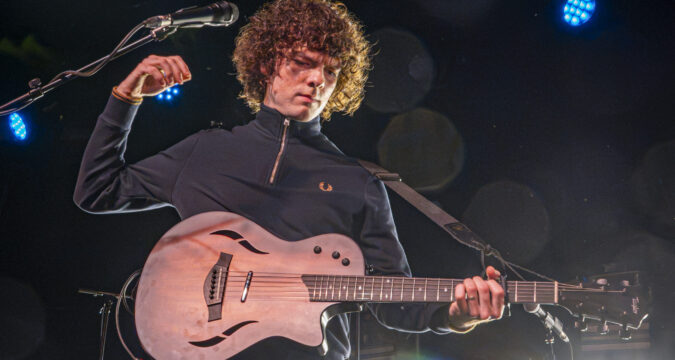
Glasgow, a Friday night and the unmistakable glow of the Barrowland Ballroom neon sign. There are few better places to spend an evening in the company of live music, and tonight I was here to discover what all the fuss was about surrounding Dylan John Thomas.
It had been a week of musical firsts for me with The Lemonheads and The Pussycat Dolls already adding unexpected chapters to my gig-going adventures. Now it was the turn of a Glasgow singer-songwriter whose name had been cropping up with increasing regularity in musical circles.
I’d heard the hype but, rather embarrassingly, hadn’t paid much attention to the music. On behalf of Scottish Music Network, it was time to put that right.
The Barras needs little introduction. The iconic neon sign, the familiar staircase, and the merchandise stalls are all part of the ritual, building anticipation before you step into that magnificent ballroom. The stage has hosted countless memorable performances, while the famous ceiling has become an attraction in its own right. For gig photographers, capturing at least one shot of it is practically compulsory. Yet, as impressive as the surroundings are, a venue is only as good as the music filling it. Tonight, with a young and increasingly excitable crowd gathering beneath that legendary roof, all the signs pointed towards a memorable night.
First up was support act Murdo Mitchell, who took to the enormous stage armed with little more than his guitar and a collection of songs. A solo acoustic performer can look rather exposed in such imposing surroundings, but Murdo showed no signs of being overawed. He carried himself with confidence and delivered a strong set, winning over an audience that was already looking forward to the main event.
There was, however, a small hiccup when a guitar string decided to call it a night before the musician himself. It could have thrown a spanner in the works, but Murdo took the setback in his stride. A couple of well-chosen covers, James’ ‘Sit Down’ and Oasis’ ‘She’s Electric’, soon had the crowd singing along enthusiastically. Sometimes a familiar tune is all it takes to turn a roomful of strangers into a temporary choir, and Murdo made the most of the opportunity. A warm reception followed, and deservedly so. Well played, fella.


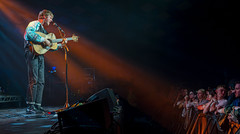


Dylan John Thomas has wasted little time making his mark on the Scottish music scene. His rise has been rapid, with support slots alongside established names such as Liam Gallagher and a previous sold-out appearance at the Barras already under his belt. There was a growing sense that this was an artist moving beyond the promise of early success and beginning to establish himself as a serious live draw.
One aspect of tonight’s ticket arrangements had, however, left a few fans scratching their heads.
Reports suggested that purchasing his new album had been a requirement to gain access to buying tickets for the show. Given that much of the audience appeared to consist of teenagers and young adults, not all blessed with money to burn, the arrangement felt a little questionable. It seemed even more peculiar when tickets were available at the door without the same album-purchase requirement.
One slightly disgruntled youngster put it rather more directly when I asked about the situation: “Ah wis a bit p****d off, to be honest, mate, but I’m in now, so sorted!”
You can always rely on a Glasgow crowd to have a good moan before getting on with the important business of enjoying themselves.
The ballroom filled to roughly three-quarters capacity, but the sheer enthusiasm of those inside made it feel considerably busier. By the time Murdo had finished, the audience was more than ready for its headliner. The familiar chant of “Here we, here we, here we f*****g go!” began to ring around the room, and the anticipation quickly reached fever pitch.
Then Dylan appeared, launching into ‘Jenna’ and giving the assembled masses precisely what they had come for. “No Dylan, no party!” came the cry from the crowd, and it was clear that nobody was planning an early departure. The party was underway almost before the opening song had properly settled.
Young they might have been, but these fans knew their way around a Glasgow gig. Phones were raised high, pals were hoisted onto shoulders, and voices were launched towards the stage with enough force to leave half the room requiring throat lozenges by Saturday morning. The atmosphere was gloriously unruly, with the sort of collective excitement that can turn an ordinary gig into something rather special.
Standing front and centre, guitar in hand and microphone at the ready, Dylan acknowledged the reception before getting down to business. He and his band worked through the set with an assuredness that suggested they were entirely comfortable in these surroundings. The songs connected, the audience responded, and the energy rarely dipped. Whatever reservations anyone might have had about the ticket arrangements, they were certainly not dampening the spirits of those inside.


The noise was ferocious at times. As an older hand at these musical gatherings, I was particularly grateful for my ear protection. There is a fine line between enjoying a gig and wondering whether your hearing will ever forgive you, and this crowd came perilously close to crossing it. The enthusiasm was infectious, though, and even a seasoned gig-goer could appreciate the sheer force of feeling being thrown towards the stage.
Interestingly, Dylan himself remained remarkably composed amid the pandemonium. He kept his interaction with the audience relatively brief, rarely giving much away as he surveyed the commotion unfolding before him. There was something effective about that contrast: while the crowd supplied the chaos, he stayed focused on the music, allowing the songs and the audience’s reaction to do most of the talking.
The Barrowland stage gives performers a commanding view of the room, and tonight that connection between artist and audience was plain to see. Singalongs, raised arms and deafening cheers came naturally. Dylan hardly needed to coax a response from a crowd that was already determined to give him everything it had.
So, did he deliver the raucous Friday-night Glasgow knees-up everyone seemed to want?
Aye, he certainly did.
Dylan John Thomas performed with the confidence of a seasoned professional, backed by a band that knew exactly how to keep the momentum going. His live impact was undeniable, and the audience’s devotion suggested that this was more than a passing infatuation. There was a genuine sense of belonging in the room, as if the crowd had collectively decided that Dylan was one of their own and intended to let the rest of the world know about it.
For someone arriving with little more than curiosity, it was an eye-opener. I’d heard the name, noticed the growing attention, and wondered whether the excitement surrounding him would translate into a convincing live performance. It did, and then some. Dylan has a natural presence, a strong connection with his audience, and the ability to turn a large room into one enormous singalong without resorting to unnecessary theatrics.
Of course, the music business is a crowded place, and talent alone never guarantees a lasting career. But Dylan has plenty in his favour: songs that resonate, a growing following, and the sort of live show that leaves people wanting another go. If he can keep building on that combination, there is every reason to believe that his upward trajectory will continue.
The Barras has witnessed its fair share of memorable nights, and this was another reminder of why Glasgow remains such a formidable live music city. I arrived knowing the name but not the music. I left with a new appreciation for the man, a better understanding of the hype, and the feeling that I’d caught a glimpse of an artist on the brink of something bigger.
If this is Dylan John Thomas on his way up, I’d suggest getting on board now. The next time he rolls into the Barras, those 1,900-odd spaces could be even harder to come by.
Well played, sir.
Review & Photographs by John Brown Photography